
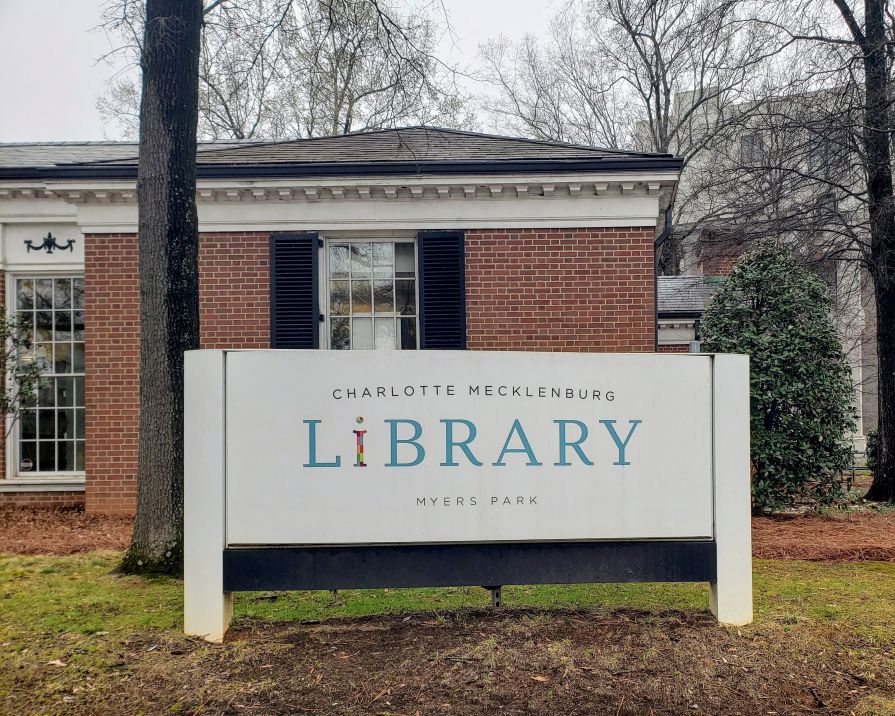
As part of Myers Park Library’s 70th anniversary, I sorted through decades of photographs and documents to create a scrapbook highlighting the branch’s history. One thing immediately caught my attention: the photographs themselves changed. Grainy black-and-white images gradually gave way to color and eventually to the vibrant digital photographs we take today. And I realized that 70 years of images provide an extraordinary lens through which to view change. The differences in the photos symbolize the branch’s history.
Myers Park Library, originally named South Branch, opened in 1956, a pivotal year for Charlotte’s libraries. The new Main Library opened that year, and on November 19, 1956, Charlotte’s public library system officially integrated. Before desegregation, Black Charlotteans were primarily served through the Brevard Street Library, where Allegra Westbrooks managed library services. In 1957, Westbrooks became Supervisor of Branches—the first African American public-library supervisor in North Carolina. Today, the Allegra Westbrooks Regional Library bears her name.
When I began pursuing my MLIS in 2017, I didn’t know Allegra Westbrooks’ story. I wish I had. But I certainly knew Dr. Carla Hayden, who in 2016 became the first woman and first African American to serve as Librarian of Congress. Seeing a Black woman leading the Library of Congress as I began my journey into librarianship mattered to me. Representation matters because sometimes we need to see someone walk through a door before we can imagine ourselves walking through it too.
I began working as a part-time library assistant at Myers Park Library in 2018, a branch where most customers and I do not share the same demographic profile. And that’s okay. In fact, diversity is a characteristic I love most about libraries
Public libraries are one of the few places where we can share space. No purchase is required. You don’t have to belong to the same social circle. You can read, learn, use a computer, attend a program, ask a question—or sit for a while.
In his book Palaces for the People, sociologist Eric Klinenberg describes libraries as part of the social infrastructure that allows relationships and communities to develop. I think of them as our free public commons: welcoming shared spaces where people who might otherwise never meet can encounter one another.
I was reminded of that during Friday’s Share Your Library Story program.
Two customers who had been coming to Myers Park Library for years began talking—and discovered that they had been high school classmates. Suddenly, a program about library memories created a new one. They might have stayed for hours catching up if we hadn’t been preparing to close for the day.
That moment seemed like the perfect ending to this anniversary project.
In my earlier My Library Story, I wrote about how libraries helped me find places where I belonged. Researching this anniversary added another chapter: learning about the library staff who helped write Myers Park Library’s story.
Perhaps that’s why those photographs stay with me.
They changed from black-and-white to color. The people represented in them changed. The people behind the desk changed. And the library became a shared space for a much broader community.
Libraries have evolved. Librarianship has evolved. There is still work to do, but there is also so much worth celebrating—including the people who opened doors before us and the responsibility we inherit to keep those doors open for those who come next.
Maybe that is one reason we preserve history. It helps us understand not only where we’ve been, but what others made possible for us. And sometimes, if we’re fortunate, we get to add our own photograph to the scrapbook.
Happy 70th Anniversary, Myers Park Library!
Here are 10 resources for exploring the history further.
- Charlotte Mecklenburg Library — Library History. The best starting point for the system’s institutional history, including the Carnegie Library, Brevard Street Library, and expansion of the system. Charlotte Mecklenburg Library
Charlotte Mecklenburg Library — Library History
- Charlotte Mecklenburg Library — Allegra Westbrooks Regional Library history. CML’s account of Westbrooks’ career, including her 1947 arrival, work at Brevard Street, and 1957 promotion. Charlotte Mecklenburg Library
Learn about Allegra Westbrooks
- Charlotte Mecklenburg Library, Robinson-Spangler Carolina Room. (2021). Systemic Racism in Mecklenburg County Government. An examination of racial inequities in Mecklenburg County institutions, including the history of segregated library service, desegregation, Allegra Westbrooks, and the development of Charlotte’s library branches.
Read the report in CML Digital Collections
- UNC Charlotte — Allegra Westbrooks Oral History. Particularly valuable because it lets Westbrooks tell the story herself. She recalls being allowed to see a white branch while being prohibited from using it, and she discusses integration and her work bringing books into Black neighborhoods. Brooklyn Oral History
Listen to the Allegra Westbrooks oral history
- Charlotte-Mecklenburg Schools — History of School Desegregation. A useful companion to the library story. It places Brown v. Board in Charlotte’s local context and documents the four Black students who entered previously white Charlotte schools in 1957. Charlotte-Mecklenburg Schools
Charlotte-Mecklenburg Schools — Desegregation History
- Tom Hanchett — Sorting Out the New South City: Race, Class, and Urban Development in Charlotte, 1875–1975. To understand why Charlotte developed as it did, Hanchett provides the broader story of race, class, neighborhoods, and urban development that surrounds the library’s history. The University of North Carolina Press
UNC Press — Sorting Out the New South City
- Wayne A. Wiegand and Shirley A. Wiegand — The Desegregation of Public Libraries in the Jim Crow South. This moves beyond Charlotte to examine the civil-rights activists—including young people—who challenged segregated Southern public libraries. The Library of Congress
Library of Congress catalog — The Desegregation of Public Libraries in the Jim Crow South
- Digital Public Library of America — Segregated Libraries. This provides accessible historical context about the limited and unequal library services available to African Americans across the South; it specifically discusses Charlotte’s Brevard Street Library. Digital Public Library of America
DPLA — Southern Library Services for African Americans
- Library of Congress — Carla Hayden. The Library’s biography documents Hayden’s historic 2016 appointment, her public-library career, and her distinction as the first woman and first African American to lead the institution. The Library of Congress
Library of Congress — Dr. Carla Hayden
- Eric Klinenberg — Palaces for the People. This is less about desegregation specifically and more about why public libraries continue to matter. Klinenberg examines libraries as social infrastructure—physical places that help people form relationships and sustain communities. Penguin Random House
Palaces for the People — Eric Klinenberg
Discover more from The Gryphonowl Chronicles
Subscribe to get the latest posts sent to your email.
