
Invitation to Hudson Bay
The late-winter sun gently streamed through the window of Ahyoka Joy Lavoie’s mobile home, the light catching the steam curling from her mug of tea. Outside, the sounds of Manitow Farm stirred—the distant hum of machinery as her uncle, Stepan, prepared equipment for spring maintenance, and the familiar lilt of her aunt, Sky, calling out to the horses as she scattered feed.
Ahyoka exhaled slowly, hesitant to open the letter in her hands. The University of Winnipeg’s crest was stamped on the top corner, her name printed in crisp black ink below. Her fingers traced the embossed seal as she considered the idea that the contents of this letter could be a defining moment in her career. Then, she unfolded the paper and began to read.
“We are pleased to invite you to join our research team in Hudson Bay this fall to document the migration of the polar bears as they return to the ice.”
A slow smile spread across her face, and her heart pounded with excitement. It was more than just an opportunity—this was her dream.
Since graduating from college, she had spent her time immersed in her work at Manitow Farm, dedicating herself to understanding how climate change was affecting boreal shrubs and plants. Her greenhouse—a renovated old barn her aunt and uncle had gifted her as a botany lab—had become her sanctuary. This was where she nurtured medicinal herbs, wildflowers, and tree barks used by her mother in her healing practice—and where she and her mother had their most important conversations.
Now, she would be taking her work further—northward to Hudson Bay, where the ice dictated survival, and the balance of nature was shifting before their very eyes.
Summer 2021 – Preparing for the Journey
The long summer days passed in a blur of research, greenhouse work, and long walks in the woods surrounding the farm.
Sky and Stepan had always been her strongest supporters, and they celebrated her acceptance into the program as though she had won an award.
“You were born for this,” Sky had told her one evening as they sat outside, watching the fire crackle in the pit. “You carry the land’s stories in your bones, just like your mother. You also have a scientist’s mind. That’s a powerful combination.”
Ahyoka had smiled, warmed by her aunt’s words. “I just want people to listen. To understand that Indigenous ways of knowing and Western science aren’t opposites—they’re part of the same truth.”
Stepan, ever the quiet presence, had nodded in agreement. “The land remembers. People just need to be reminded to listen.”
And so, she prepared—reading every research paper she could get her hands on, sharpening her skills in tracking, navigation, and survival, skills passed down from her maternal grandparents, who had taught her how to move through the forests without disturbing them.
October 2021 – A Warning in Stone
The research team had set up their camp near Arviat, Nunavut—a cold and foreboding landscape of moss, permafrost, and rocky outcrops. The dazzling colors of the fireweed and Arctic poppies had given way to frost and snow.
The Arctic wind sliced through her parka as Ahyoka stood near the frozen shoreline of Hudson Bay, camera in hand, tracking the movements of the polar bears.
For weeks, she had watched them pace along the ice’s edge, waiting for the freeze that came later each year. Some were too thin. Some lingered too long. She had seen the patterns shifting, their migration slowing. Polar bear populations have decreased by half of the last 40 years.
But something else caught her attention that day.
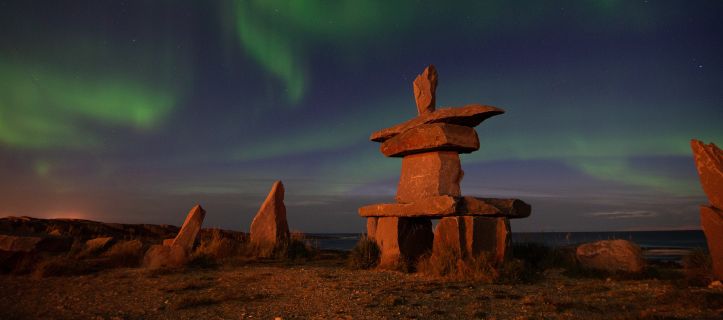
In the distance on a lichen-covered ridge, an inukshuk stood alone against the sky.
Ahyoka’s breath hitched. She had always been fascinated by these ancient stone markers—silent guides that spoke without words. Her grandfather had taught her to read them, explaining their purpose: some pointed to safety, others to food.
But this one…
This one was different.
The placement of its stones was a warning.
It was telling travelers that something dangerous was ahead.
Her pulse quickened as she stepped closer, careful not to disturb the rocks or the ground around them. Someone had built this deliberately, and recently.
She raised her camera and took a photo.
Later, as she reviewed her footage, she noticed other details that hadn’t registered at first—subtle but unsettling. Bright survey flags, barely visible against the snow. Unmarked aircraft passing overhead. A dark, geometric shape of a distant prefabricated structure on the horizon.
She frowned, flipping back through her footage.
This wasn’t normal.
At the time, she didn’t fully understand what she had captured. She filed the images away, focusing on her research, unaware that she had just documented the first signs of unauthorized oil exploration in a protected Arctic region.
Ecology, Economics, and Crisis
In the months after her return from Arviat, Ahyoka resumed her research focusing on the delicate balance between climate change, Indigenous plant knowledge, and sustainable harvesting practices. While her earlier fieldwork had taken her to Nunavut to document the polar bears’ migration, her passion is studying indigenous plants, shrubs, and trees vital to both the cultural and economic livelihood of Indigenous communities. The question at the heart of much of Ahyoka Lavoie’s work is simple but urgent:
“How do we ensure that the land continues to provide for future generations?”
That was the focus of her conference presentation in June 2022, when she traveled to Winnipeg to speak at a conservation event. Her talk centered on sustainable growing and harvesting practices, emphasizing how traditional ecological knowledge could guide responsible foraging, community-led land stewardship, and Indigenous economic sovereignty. She highlighted the increasing demand for wild blueberries, cloudberries, and chaga in commercial markets and warned about the risks of overharvesting and corporate exploitation.
It was after this presentation that Daniel LaChance, a Métis environmentalist, approached her.
“I’ve been following your work for a while,” he said as they walked through the event space. “I respect how you bring Indigenous knowledge into conservation. Too many people treat it as an afterthought.”
Ahyoka had heard Daniel’s name before. He was known for his fierce advocacy against resource extraction projects that threatened Indigenous lands. Curious about his perspective, she told him about her recent trip to Arviat. She mentioned the inukshuk she had found—the one that warned travelers to stay away.
Daniel’s expression darkened. “Did you document it?”
“I took photos,” she replied. “And some footage.”
“Can I see it?”
At first, it was nothing more than curiosity—two researchers sharing knowledge. But as Daniel scrolled through the images on her laptop, his face grew serious. He saw something she hadn’t.
He zoomed in on survey markers, barely visible against the snow. He pointed to the tracks left by thumper trucks, used for seismic testing. His fingers traced low-flying aircraft that shouldn’t have been there, moving in unnatural patterns over the tundra.
Then, there were the unmarked supply depots and prefabricated structures, nestled in the landscape, hidden but deliberate.
Daniel exhaled sharply. “You didn’t just capture polar bears,” he muttered. “You captured something much bigger.”
Ahyoka frowned. “What do you mean?”
Daniel leaned back, running a hand over his beard. “I’ve been hearing things. Whispers about foreign interests—American and Russian—maneuvering for control over Arctic oil reserves. There are rumors that companies are laying the groundwork for full-scale extraction, destabilizing northern economies to force through development projects.”
Ahyoka shook her head. “That sounds… extreme.”
“I thought so too,” he admitted. “But the more I hear, the more it makes sense. If there’s oil under protected Arctic land, do you think corporate investors care about treaties? About conservation laws?”
A slow, chilling realization settled in.
At first, she tried to rationalize it. She had been focused on the plants, on the bears, on the shifting climate. But now she wondered: Had she unknowingly documented the first signs of unauthorized oil exploration?
From August to December 2022, Daniel became more convinced that the Arctic wasn’t just a battlefield for climate change—it was a geopolitical chessboard. He tracked land acquisitions, corporate mergers, and government policy shifts that all seemed to point to a coordinated push toward large-scale resource extraction.
At first, even Daniel had dismissed some of the rumors as conspiracy theories, but the evidence kept mounting.
“This isn’t just about conservation,” he warned Ahyoka one evening over coffee. “This is about control. And if we’re not careful, someone’s going to make sure we stay quiet.”
Silence, Death, & Secrets (2023)
By January 2023, Ahyoka had distanced herself from what she had seen at Arviat. Her world consisted of her botany research, tending to her greenhouse at Manitow Farm, and foraging for ingredients for medicinal teas. She told herself that her time was better spent on something tangible—advocating for Indigenous-led land stewardship and sustainable harvesting practices—rather than dwelling on the unsettling discoveries she and Daniel LaChance had stumbled upon.
But something kept nagging her.
The Inukshuk.
It had appeared on the road to Arviat, Nunavut, one of the northernmost communities along Hudson Bay.
She knew that Inuksuit were part of Inuit tradition, not Cree culture. The stone structures, placed by Inuit travelers for thousands of years, held specific meanings—guidance, navigation, the location of food storage or hunting paths, tributes to ancestors, or warnings about dangerous ice and roads. In recent years, Inuksuit had become widely recognized across Canada, even used as a national symbol during the 2010 Vancouver Winter Olympics.
Indigenous communities had always emphasized something crucial: Inuksuit should be respected, not misused. Fake or improperly placed ones could mislead travelers. People had been honoring that request.
So why had this one appeared now?
It wasn’t a tourist attraction. It wasn’t a tribute. It wasn’t part of an old hunting path.
Its placement, its shape—this was a warning.
A warning of thin ice and danger.
Now, as she thought back to her footage from Arviat—the survey flags, the low-flying aircraft, the dark shapes of unmarked buildings against the tundra—she felt a chill that had nothing to do with the winter wind outside.
She wanted to believe Daniel was overreacting. She wanted to believe that the pieces didn’t form the picture he thought they did.
But Daniel wasn’t done digging.
By April 2023, he had collected enough evidence to confirm what he had feared—someone was expanding illegal operations near Hudson Bay, and it wasn’t just about drilling. It was about political and corporate forces working together to destabilize Canadian sovereignty, clearing the way for foreign-controlled resource extraction.
He needed help.
That was when he reached out to an investigative journalist—Gregory Gault.
Without telling Ahyoka, Daniel sent an anonymous email containing leaked documents, references to corporate acquisitions, and hints at government insiders facilitating Arctic resource exploitation.
He was careful. He knew this information was dangerous.
Yet a few weeks after reaching out to Gregoy Gault, Daniel LaChance was found drowned near Lake Athapapuskow.
Authorities called it an accident. But Ahyoka knew better.
A Storm is Coming
Over the summer of 2023, Gregory Gault began his investigation into Daniel’s death and the web of corruption surrounding Arctic drilling operations. He followed leads, uncovered high-level corruption, but hadn’t yet connected Ahyoka to Daniel’s research.
By August 2023, Ahyoka had returned to Hudson Bay. Something was pulling her back. Reports of increased aircraft activity, newly marked ice roads, and quiet conversations about corporate interests moving into the region made her uneasy. She began gathering new evidence, still unsure what to do with it.
And now there was another new Inukshuk—this time near Churchill. This one shook Ahyoka to the core. If she understood the symbolism correctly. There were engravings of Sila, The Spirit of the Arctic and the Northern Lights and, Nanook the Great Polar Bear spirit
Late November – The Weight of Silence
The drive from Thompson Regional Airport to Manitow Farm was quiet. The landscape outside was swallowed in early winter’s darkness, the headlights of Stepan Rudenko’s truck illuminating the frost-lined edges of the road.
Ahyoka sat in the passenger seat; her fingers curled into the sleeves of her sweater. The scent of pine and frigid air clung to her clothes from Churchill, mixing with the lingering jet fuel from the small plane. She hadn’t said much since Stepan picked her up, and, as always, he didn’t press her to talk.
That was one of the things she appreciated about Stepan—his quiet, steady presence. Unlike Sky, who could always sense when something was amiss and tried to coax the truth out with warmth and storytelling, Stepan knew that some truths couldn’t be pulled—they had to be given, freely and in time.
Ahyoka closed her eyes briefly, thinking of the inukshuk on the road to Arviat—the one placed there not as a guide, but as a warning. A warning for those who still understood.
Something was very wrong.
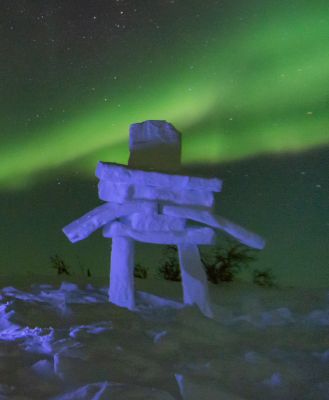
Her mind drifted back to the carvings she had seen in Churchill—etchings of Sila, the Spirit of the Arctic and the Northern Lights, and Nanook, the Great Polar Bear spirit. These weren’t just symbols. Sila was the breath of the wind, the force of the storm, the rhythm of nature itself. Nanook was the guardian of the bears, the one who watched over the hunters and the hunted alike.
If someone was calling to them—if their names were being invoked in stone, in whispers, in warnings—then something was deeply, terribly wrong.
As they neared the farm, the first glow of light from Manitow Inn flickered through the trees. Sky had insisted she stay in the Inn instead of her trailer—and for once, Ahyoka hadn’t fought it.
Sky knew something was wrong.
She had sensed it for a long time now.
Ahyoka had tried to bury it, tried to convince herself that it wasn’t as bad as she feared. But after what she had seen in Churchill, after the whispers she had heard, after the inukshuk warning on the road to Arviat—she couldn’t ignore it anymore.
The moment she stepped into the warmth of the Inn, Sky was there, arms open, pulling her into a firm embrace.
Ahyoka let herself sink into the comfort of it for just a moment, breathing in the scent of cedarwood and the faint traces of the spiced cider Sky must have been making.
“Welcome home, my girl,” Sky murmured. “You must be frozen.”
“I’m okay,” Ahyoka said softly, though they both knew it wasn’t true.
Sky pulled back, studying her niece’s face, searching for something. Ahyoka felt the weight of her gaze but said nothing.
“You must be tired,” Sky finally said, her voice gentle. “Get some rest. You’re where you need to be.”
Ahyoka nodded, offering a small smile before heading straight to her room.
She sat on the edge of the bed, her duffel bag still untouched at her feet. Outside, the wind howled through the trees, shaking the windowpanes.
She needed to talk to someone.
She needed to tell someone everything—what she had found, what she suspected, what Daniel had feared before he died.
But she hesitated.
If she spoke, if she confided in Sky, or in Erik, or in Grace… was she putting them all in danger?
Her mind flashed back to Daniel LaChance, to his relentless determination to expose the truth. To the way he had warned her—this isn’t just about conservation. This is about control. And if we’re not careful, someone’s going to make sure we stay quiet.
And then, just weeks later, Daniel had been found drowned.
A shiver ran down her spine.
She wasn’t just afraid of what she had uncovered. She was afraid of what it meant.
And she was afraid of who else might already know that she knew.
Outside, the sound of footsteps echoed down the hallway. Laughter—Erik and Grace. Sky had been trying to get her to open up, and she had hoped that Ahyoka would feel comfortable around them.
Ahyoka took a deep breath.
Maybe Sky was right.
It was time to stop carrying this alone.

You must be logged in to post a comment.