
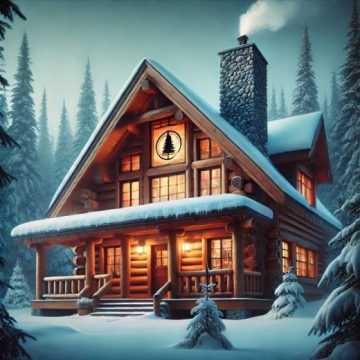
Under the Northern lights. the land knows its own, the waters refresh, the roots run deep. The wind carries whispers of what is to come, the fire remembers what was. The earth heals and what is meant to be will find its way
“Tāhtāpānask ē-pī-māyan, askī kī-wāpihtam āniskō-kiskēyihtamowin.
Nipiy kī-nīpahow, ōtināhk kī-kākwayāstam.
Yōtin kī-ati-āyahcikātēw, kā-kī-isi-pimatisiyān.
Askiy kī-mamihcimow,
kā-ati-āyiman kī-wāpahtam kā-isi-wīcihitowak.”
After a long, sleepless night Erik headed out to the cabin. The weather forecast called for a possible thirty centimeters of snow and high winds and he needed to be sure that the tarps would collapse or be dislodged by the wind. The road to the cabin stretched dark and silent before him, the headlights cutting through the early morning mist.
As he reached the cabin the sun peeked over the horizon, painting the sky in shades of purple and gray. The wind had picked up, biting against his skin as he stepped out of the truck. Erik meticulously checked the anchor boards and stones securing the tarps over the roof and unfinished rooms. Once he was satisfied that the tarps would hold off the snow and wind through the storm, he stepped inside, shaking the cold from his fingers. He walked through the shell of the living room into the first-floor bedroom and smiled at the thought of waking up to the sunrise.
He loved this time of day particularly when he had someone to share it with. He was always at his best after a good night’s rest. He looked forward to a morning in his own bed—a morning when he didn’t slip away before the sky even hinted at dawn. A crisp morning when he’d turn over to find someone still tangled in his sheets, her body pressing into the warmth of his. A body waiting to be passionately awaken-embers to be stoked.
With that thought on his mind, Erik walked into the kitchen and stood in front of the hearth, staring at the carved stones that had warmed his family for generations The kitchen work was nearly finished, the scent of sawdust and fresh wood lingering in the air, but the hearth stood cold and empty. No fire crackled within its great stone frame, only silence and the faint whisper of the wind slipping through the damper and flue, despite the cap on the chimney.
Erik rested his hands on the wooden mantle, fingers tracing the familiar carvings, their meaning as deeply etched in him as they were in the wood. Mistik Awasis, the Spirit Tree, an image of a Black Spruce, its roots anchored in the past, its branches reaching toward the unknown. The Flowing River and the Northern Lights, a tribute to the land and the ancestors who had vowed to protect it. And finally, Maskwa, the Guardian Bear—the mark he had left, his unspoken promise to stand watch over this place. The only warmth in the cabin came from the portable heater in the corner, its artificial heat a poor substitute for the fire that had once made this place a home.
Soft morning light filtered through the windows, the shadows deepened by the glow of the camping lanterns placed around the room. He had loved this cabin since he was a boy. The first time his parents had brought him here, he had felt a sense of belonging, of being part of something older than himself. But now, after coming here to live, after everything that had happened, people continually talked about magic, legends, and prophecies, some days it all felt a little crazy.
Sure, he’d grown up hearing the stories—how the house had never burned, how no fire had ever touched its walls beyond the embrace of the hearth. No ember had ever leapt from the fireplace to catch upon the wood. No lightning strike had ever set the roof aflame. No wildfire had ever crossed its threshold, as if held back by invisible hands.
He had always thought of those stories as just stories.
But now?
Now he wondered if there really was something mystical about the cabin.
There were stories that said the hearth stones had been pulled from the river, carrying the spirit of water within them, always keeping the flames in check. Others said it was the whispering trees, the spirits of the forest woven into the very bones of the house, watching, protecting.
Erik could still hear Marc-André’s voice as he told him the story of how the cabin had come to be—not just built, but born from the land itself. Nicolas and Bonnie Pelletier hadn’t simply gathered materials; they had listened, asked, and waited for an answer.
“Before your great-grandfather felled a single tree,” Marc-André had told him, “He and Bonnie stood in the forest and asked for permission, as the Cree did.” That night, beneath the shimmer of the northern lights, Bonnie dreamed of trees speaking to her—a vision of an ancient pine standing tall against the sky, whispering, Take only what is freely given. In return, we will stay with you. We will listen. We will protect.
In the morning, Nicolas found what they needed—not by axe and will, but by grace. Three pines, a cedar, and an old oak, felled not by man but by the storm, their trunks unmarked by rot, waiting as if offering themselves. These became the bones of the cabin—the beams that held the roof, the walls that embraced each winter wind, the floorboards that carried the weight of every footstep, every story, every life that passed through.
Until the knee injury, he had spent his whole life on the ice, skates on, stick in hand, knowing exactly who he was. That was his world. Now, here he was trying to keep a promise to restore this cabin
Erik rested on the granite countertop and thought back to the day of Marc-Andre’s funeral.
Earlier that day, his family had stood beside him at the cemetery, their faces tight with grief and cold. They had come up from Nebraska, prepared for the biting northern wind, bundled in thick coats and scarves to keep out the -10°C chill. His nieces and nephews had shivered, their breath rising in small clouds of disbelief at how anyone could live in this kind of cold.
He had heard the whispers.
“Why would Erik stay here?”
“He had a life before all this.”
“He’s just lost. Grief does that to people.”
And they were right.
His parents and his sister’s family had opted to stay at Manitow Inn, somewhere with reliable heating, running water, and a sturdy roof. His brothers had checked into area motels, unwilling to subject their wives and children to the state of the old cabin.
But Erik had come here.
Back to the house that now belonged to him. The house that he had promised to rebuild—but was already wondering if he could.
The cabin had always been a place of strength, of memories. As a kid, he had loved it, running through the woods, sitting by the fire as his grandfather told stories late into the night. It had felt permanent, unbreakable. But now, standing here as its keeper, the weight of it pressed down on him.
What the hell was he doing?
He was a hockey player, at least he had been. His world had been arenas, bright lights, cold ice beneath his skates, the rush of adrenaline in his veins. Sure, he had worked with his father doing construction in the off-seasons, but this?
This was different.
This wasn’t just wood and stone—it was a legacy, a house full of stories and whispers of a past he didn’t fully understand.
And now, all anyone seemed to talk about was the prophecies.
The legends. The magic.
Elder Maskwa-Napew had been the first to tell him what the house meant. That had been the evening after the funeral, when the Elder had walked through the door unannounced, stepping inside as if the cabin itself had invited him.
Even now, Erik could picture him—a tall, lean man, his long silver hair tied back in a single braid, dark eyes filled with the weight of generations. His face was lined, not just with age, but with wisdom, with the knowing of a man who had lived long enough to see history repeat itself.
Elder Maskwa-Napew had not spoken right away. He didn’t have to.
He saw Erik—saw the way he had swallowed his grief, how he had stood stiffly, trying to keep the weight of it buried beneath his ribs. He saw the way Erik’s confidence—so natural in every other part of his life—was beginning to crack under the uncertainty of everything that lay ahead.
And when Elder finally spoke, his words settled over Erik like a blanket.
“The Bear has returned, but the Forest waits.”
Erik had let out a breath, shaking his head. “I don’t know what that means.”
Maskwa-Napew had stepped closer, resting one weathered hand against the mantle, tracing the carved Black Spruce, its roots and branches stretching between the realms of earth and sky.
“You must rebuild this house, Erik. Not just with your hands, but with your heart. It is Mistik Sâkihowin—the Tree of Love and Mistik Awasis, the Spirit Tree. Its roots are in this land, and so are yours.”
That had been the moment Erik had felt it—the weight of the truth.
He hadn’t just come back because of his grandfather.
He hadn’t stayed because there was a cabin to rebuild.
Something deeper had brought him here.
Even if he couldn’t quite explain it.
“I don’t know if I can do it,” he had admitted then, the words low, raw, barely above a whisper.
“ I know that my grandfather left me enough money to rebuild, but to rebuild it in a way that preserves enough of the original structure is another thing”
Maskwa-Napew had turned, his expression unwavering. “You will. And you will not do it alone.”
Erik had frowned. “What do you mean?”
And then, the Elder had spoken the prophecy of the arctic fox.
He had told Erik of the one who was coming—of the woman who carried the spirit of the fox, who walked between two worlds, who did not yet know she belonged here.
He had spoken of love, of a bond that would be tested but unbreakable, of a life waiting to be shared, a home that would finally be complete.
“She will come to you not in winter’s fur, but as she truly is. And when you see her, you will know,” said the Elder.
Erik had wanted to laugh then, to brush it off, to tell the Elder that he had just crawled out of the wreckage of a marriage that had burned him worse than fire ever could.
Instead, he had only said, “A trickster? Great. That’s exactly what I need.”
Maskwa-Napew had laughed—a deep, rumbling sound that had made the cabin feel less empty.
“You still have much to learn.”
Maskwa-Napew let out a deep, rumbling chuckle, shaking his head. “Ah, Erik.” His eyes gleamed with amusement. “You still have much to learn.”
The Elder turned back toward the fire. “In our stories, the Trickster is not always an evil spirit. Sometimes, yes, they bring chaos. But often, they bring change. They show us things we do not want to see. They challenge us. They force us to grow.”
Maskwa-Napew gestured toward the fire, as if the flickering flames held the truth of his words.
“The Arctic Fox is not just a trickster. It is a guide, a bridge between two worlds. It does not follow the paths others have laid—it makes its own way. It knows how to endure the longest winters, how to move unseen, how to outwit those who would do it harm. And when it sheds its winter camouflage, it no longer hides. It reveals itself, as it truly is.”
His gaze flicked back to Erik, sharp and knowing.
“When the Arctic Fox comes to you, Erik, it will not be in winter’s fur. It will not be hiding. And neither will she.”
Erik’s smirk softened.
“You are the Bear,” the Elder continued. “Rooted, steady, protector of this land, this home, this family. But even the Bear does not walk alone forever. The Arctic Fox is meant to find you—to challenge you, to teach you, to wake up something inside you that has been asleep for too long.”
And now, standing here in the present, in the quiet before the storm, Erik couldn’t ignore the truth pressing at the edges of his doubt.
Last night he had seen the Arctic Fox—not in a dream—not in a blurry half-memory.
He saw a lone arctic fox with brown and gray fur, wandering through Manitow Farm.
And when had he seen it?
He had been thinking about Grace.
He wasn’t sure if he believed in spirits, in visions, in the voices of the land calling to him through fire and wind.
But he couldn’t deny what he had seen. He saw an Arctic Fox.
The more time he spent in Manitoba, the harder it was to deny that things were happening—things he couldn’t explain.
And if there was truth to the legends of this house, if there was truth in Elder Maskwa-Napew’s prophecies, then his life was about to change forever.
